

We need to have an honest conversation. You’ve probably been on a diet more times than you can count. You know the drill: Sunday night, you clear out your pantry, throw away the snacks, and promise yourself that this time will be different. Monday morning, you wake up, eat a tiny bowl of plain oatmeal, and force yourself onto the treadmill for an hour.
By Wednesday, you are exhausted, irritable, and starving. By Friday night, the willpower runs out. You eat a slice of pizza, which turns into a whole pizza, followed by ice cream. The guilt washes over you. You look in the mirror, feel a deep sense of failure, and tell yourself that you just don’t have the discipline.
I am here to tell you something that the mainstream fitness industry refuses to admit: You are not lazy, you do not lack willpower, and you are not broken.
Your previous weight loss attempts didn’t fail because of a character flaw. They failed because you were fighting a biological war against your own body using the wrong weapons. The classic advice of “eat less and move more” has trapped millions of people in a vicious cycle of losing 10 pounds only to gain back 15.
It is time to step off the hamster wheel. In this guide, we are going to dismantle the toxic diet culture, heal your metabolism, and show you the sustainable, science-based path to losing fat permanently—without starving yourself.
1. The 1,200-Calorie Starvation Trap (And Metabolic Damage)
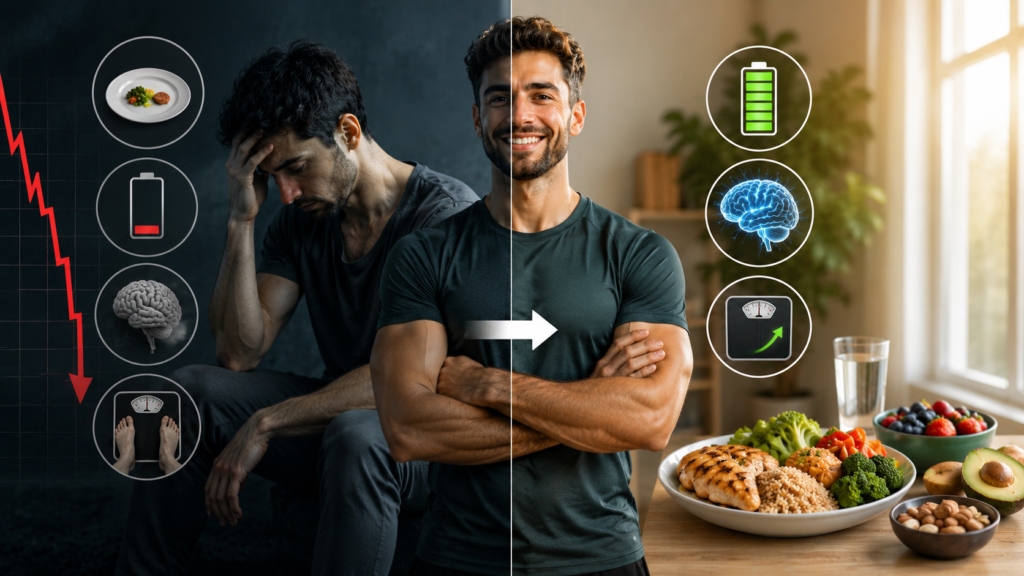
The biggest lie in the weight loss industry is that eating as little as possible is the fastest way to lose fat. Many popular diet apps will put grown adults on a 1,200-calorie-per-day restriction. This is a biological catastrophe.
When you suddenly drop your calories to starvation levels, your body does not say, “Oh great, let’s burn all this stored body fat!” Instead, your brain senses a famine. Your evolutionary survival mechanisms kick in.
To keep you alive, your body drastically slows down your Basal Metabolic Rate (BMR). It stops spending energy on non-essential functions. You start feeling cold all the time. Your hair might thin out. You feel lethargic, brain-fogged, and depressed. Your body becomes incredibly efficient at holding onto every single ounce of fat because fat is its emergency fuel source.
Worse yet, the weight you do lose on a crash diet is often water and precious muscle tissue. When you finally stop the diet (because nobody can eat 1,200 calories forever), your metabolism is now slower than it was before you started. When you return to eating normally, your body rapidly stores that food as fat to prepare for the “next famine.” This is the Yo-Yo dieting trap.
The Fix: You must eat to lose fat. You need a highly calculated, slight caloric deficit. A deficit of 300 to 500 calories below your maintenance level is the sweet spot. This allows your body to gently tap into fat stores without sounding the starvation alarm. You should be losing weight while feeling energized, not miserable.
2. The Hormone Equation: It’s Not Just About Calories

“A calorie is a calorie.” This statement is true in a physics lab, but inside the human body, calories trigger complex hormonal responses. If you are struggling to lose belly fat, you need to look at your master fat-storage hormone: Insulin.
Every time you eat carbohydrates—especially processed carbs and sugars—your blood sugar spikes. Your pancreas releases insulin to bring that blood sugar down. Here is the critical fact: When insulin is high in your bloodstream, fat burning is biochemically locked. Your body physically cannot burn stored body fat while insulin is elevated.
If you are snacking on granola bars, sipping sweetened coffees, and eating small, frequent, carb-heavy meals 6 times a day, your insulin levels are perpetually high. You are keeping your fat cells locked shut.
The Fix:
- Prioritize Protein and Healthy Fats: Protein and fats have a minimal impact on insulin spikes. They also trigger the release of Leptin (the fullness hormone) and suppress Ghrelin (the hunger hormone). A breakfast of eggs and avocado will keep you full for hours, whereas a bowl of sugary cereal will leave you starving 90 minutes later.
- Stop Snacking: Eat 3 to 4 solid, satisfying meals a day, and stop eating between them. Allow your insulin levels to drop back to baseline so your body can actually open the fat cells and use them for energy.
3. The Cardio Myth: Stop Running Yourself into the Ground

When people decide to lose weight, the first thing they do is start jogging. They spend hours sweating on the elliptical, staring at the “calories burned” screen.
Here is the heartbreaking truth about traditional cardio: Your body is incredibly adaptive. If you run 3 miles every day, your body eventually figures out how to do it using less energy. The 300 calories you burned running last month might only be 200 calories this month. Plus, excessive cardio elevates Cortisol (the stress hormone), which can increase cravings for sugary, high-fat foods.
The Fix: Build a Bigger Engine (Strength Training). Cardio burns calories while you are doing it. Strength training builds muscle, which burns calories all day long. Muscle is metabolically active tissue. The more muscle you have on your frame, the more calories your body burns while you are sitting at your desk, driving your car, or sleeping.
You do not need to become a bodybuilder, but lifting weights 3 times a week will reshape your body, tighten your loose skin, and permanently increase your daily resting metabolism.
4. The Magic of NEAT: The Hidden Fat Burner

You don’t need to destroy yourself in the gym for two hours a day to lose weight. In fact, formal exercise only makes up a tiny fraction of your daily caloric burn. The real magic lies in NEAT (Non-Exercise Activity Thermogenesis).
NEAT is all the movement you do outside the gym: walking to your car, carrying groceries, taking the stairs, cleaning the house, or playing with your kids.
Modern society has engineered NEAT out of our lives. We sit at our desks, we sit in our cars, and we sit on our couches. You can do the most intense 45-minute spin class in the world, but if you sit completely still for the other 23 hours of the day, you will struggle to lose weight.
The Fix: Increase your baseline movement. The “10,000 steps a day” rule is not just a gimmick; it is a highly effective way to keep your metabolism humming without spiking your hunger or stressing your joints. Park further away from the store. Take a 15-minute walk after lunch. Stand up while taking phone calls. These tiny movements compound into massive fat loss over time.
5. The “All-or-Nothing” Psychological Trap

Perhaps the biggest barrier to sustainable weight loss is perfectionism. You eat perfectly clean from Monday to Thursday. On Friday, a coworker brings donuts to the office, and you eat one.
Immediately, the “All-or-Nothing” mindset kicks in. You tell yourself, “Well, I ruined my diet. The day is ruined. I might as well eat whatever I want this weekend and start over on Monday.”
This mindset is destructive. Eating one donut does not make you gain fat, just like eating one salad does not make you lose fat. What makes you gain or lose weight is what you do consistently over months and years.
The Fix: Practice self-compassion. If you drop your phone, you don’t smash it into pieces because it has a scratch; you pick it up and keep going. Treat your nutrition the same way. If you have a meal that isn’t aligned with your goals, enjoy it, forgive yourself immediately, and make sure your very next meal is a healthy, protein-rich plate.
Consistency will always beat perfection.
A New Beginning: Healing Your Relationship with Food
The journey to losing weight and keeping it off is not a punishment. It is a process of healing. You are not dieting to shrink yourself down so you take up less space in the world; you are nourishing your body so you can live a longer, stronger, and more vibrant life.
Throw away the extreme crash diets. Stop punishing yourself on the treadmill. Start eating nutrient-dense, satisfying meals that balance your hormones. Start lifting weights to build a strong, resilient frame. Move your body daily because it feels good, not because you are trying to burn off something you ate.
Weight loss is not a 30-day challenge. It is a lifelong commitment to treating your body with the respect and care it deserves. Be patient with yourself, trust the science, and take it one day, one meal, and one step at a time. The results will follow.
For more helpful information, click here.