

If you are carrying a significant amount of excess weight, the fitness industry can feel like an incredibly intimidating place. When you search for weight loss advice online, you are immediately bombarded with images of shredded fitness models, complex meal prep routines, and extreme high-intensity workouts that require you to jump around like a professional athlete.
For someone who is severely overweight or obese, these standard routines are not just discouraging—they can actually be dangerous for your joints and your metabolic health. You do not need to run a marathon, and you do not need to starve yourself on a diet of celery and water.
If you are wondering exactly how to start losing weight when overweight, you have finally found the right place. This comprehensive guide will break down the science of fat loss into realistic, sustainable, and actionable steps tailored specifically for heavy beginners. Let’s rebuild your health from the ground up.
Phase 1: The Mindset Shift (Stop the “All or Nothing” Cycle)
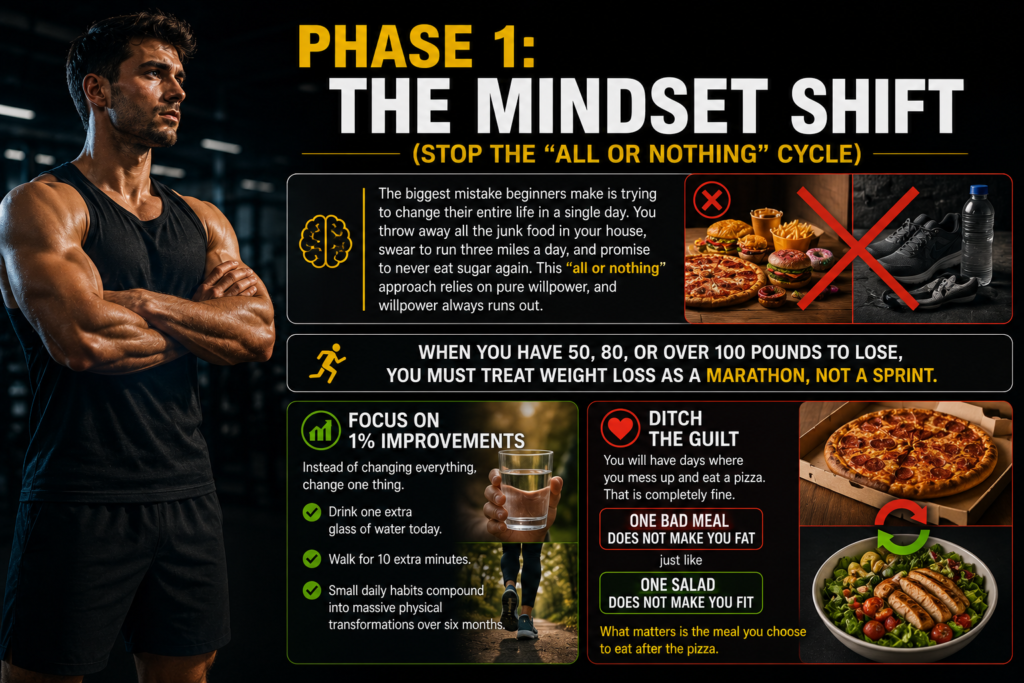
The biggest mistake beginners make is trying to change their entire life in a single day. You throw away all the junk food in your house, swear to run three miles a day, and promise to never eat sugar again. This “all or nothing” approach relies on pure willpower, and willpower always runs out.
When you have 50, 80, or over 100 pounds to lose, you must treat weight loss as a marathon, not a sprint.
- Focus on 1% Improvements: Instead of changing everything, change one thing. Drink one extra glass of water today. Walk for 10 extra minutes. Small daily habits compound into massive physical transformations over six months.
- Ditch the Guilt: You will have days where you mess up and eat a pizza. That is completely fine. One bad meal does not make you fat, just like one salad does not make you fit. What matters is the meal you choose to eat after the pizza.
Phase 2: Mastering the Fuel (Nutrition Without Starving)
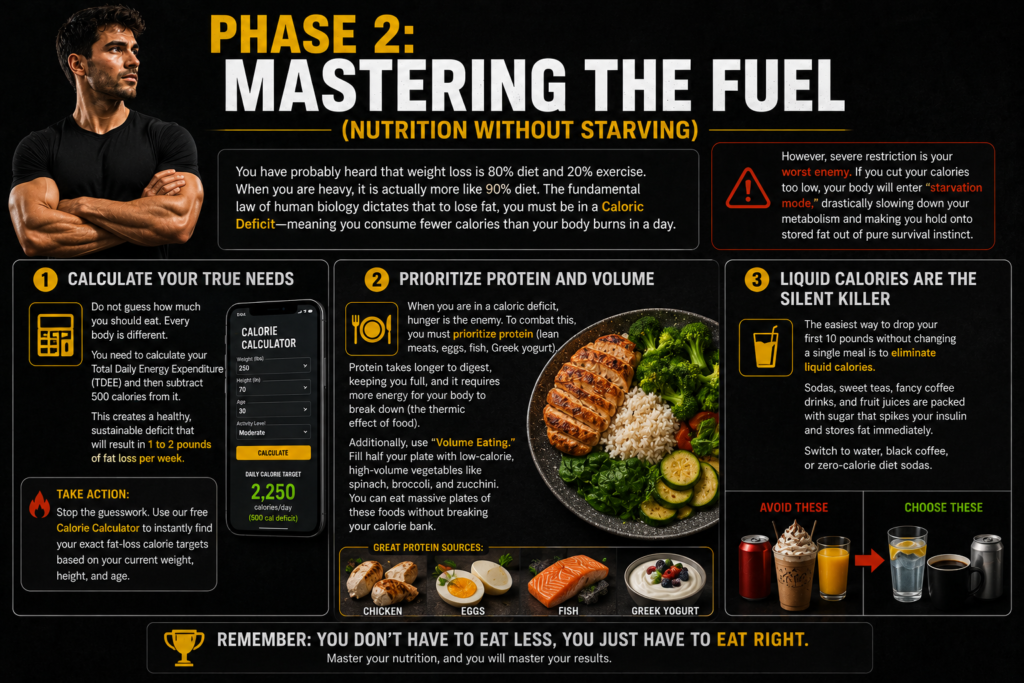
You have probably heard that weight loss is 80% diet and 20% exercise. When you are heavy, it is actually more like 90% diet. The fundamental law of human biology dictates that to lose fat, you must be in a Caloric Deficit—meaning you consume fewer calories than your body burns in a day.
However, severe restriction is your worst enemy. If you cut your calories too low, your body will enter “starvation mode,” drastically slowing down your metabolism and making you hold onto stored fat out of pure survival instinct.
1. Calculate Your True Needs Do not guess how much you should eat. Every body is different. You need to calculate your Total Daily Energy Expenditure (TDEE) and then subtract 500 calories from it. This creates a healthy, sustainable deficit that will result in 1 to 2 pounds of fat loss per week.
Take Action: Stop the guesswork. Use our free [Calorie Calculator] to instantly find your exact fat-loss calorie targets based on your current weight, height, and age.
2. Prioritize Protein and Volume When you are in a caloric deficit, hunger is the enemy. To combat this, you must prioritize protein (lean meats, eggs, fish, Greek yogurt). Protein takes longer to digest, keeping you full, and it requires more energy for your body to break down (the thermic effect of food). Additionally, use “Volume Eating.” Fill half your plate with low-calorie, high-volume vegetables like spinach, broccoli, and zucchini. You can eat massive plates of these foods without breaking your calorie bank.
3. Liquid Calories are the Silent Killer The easiest way to drop your first 10 pounds without changing a single meal is to eliminate liquid calories. Sodas, sweet teas, fancy coffee drinks, and fruit juices are packed with sugar that spikes your insulin and stores fat immediately. Switch to water, black coffee, or zero-calorie diet sodas.
Phase 3: Movement (Protecting Your Joints)
When figuring out how to start losing weight when overweight, exercise selection is critical. Traditional cardio, like jogging or jumping jacks, places immense force on your knees, hips, and ankles. For a heavy individual, this is a one-way ticket to an injury that will sideline your progress for months.
You need to focus on low-impact, high-efficiency movement.
1. The Magic of NEAT (Non-Exercise Activity Thermogenesis) NEAT refers to the calories you burn doing normal daily activities outside of structured exercise. This is your secret weapon. Park your car at the back of the parking lot. Take the stairs instead of the elevator. Pace around your living room while talking on the phone. Increasing your NEAT can burn up to 500 extra calories a day with zero joint strain.
2. Walking: The Ultimate Fat Burner Walking is the single most underrated fat-loss exercise on the planet. It is low-impact, requires no equipment, and utilizes stored body fat as its primary fuel source. Start with just 15 minutes a day. Put on a podcast or your favorite music, and simply walk around your neighborhood. Every week, add 5 minutes to your walk until you are comfortably walking for 45 to 60 minutes a day.
3. Resistance Training (Building the Engine) While cardio burns calories in the moment, lifting weights builds muscle. Muscle is metabolically active tissue. The more muscle you carry underneath your fat, the more calories your body burns around the clock—even while you are sleeping. You do not need heavy barbells right away. Start with bodyweight exercises modified for your size:
- Wall Push-ups: Instead of getting on the floor, stand a few feet away from a wall and perform push-ups against it.
- Chair Squats: Sit down in a sturdy chair, and stand back up using your leg power. Repeat 10 times.
- Water Jug Rows: Grab two heavy water jugs and pull them toward your chest to build back strength.
Phase 4: Overcoming the Hormonal Roadblocks
Sometimes, you can do everything right—eat in a deficit, walk every day—and the scale still refuses to move. When you are severely overweight, your hormones are often working against you.
1. Tackling Insulin Resistance Years of carrying excess weight and eating highly processed carbohydrates can make your cells resistant to insulin. When insulin levels are constantly high, your body is in a perpetual “fat-storage” mode, making it nearly impossible to burn fat. To fix this, reduce your intake of refined sugars and white flours, and focus on complex carbs with high fiber (like oats, sweet potatoes, and beans) to keep your blood sugar stable.
2. The Cortisol Connection (Stress and Sleep) When you are stressed or sleep-deprived, your body produces massive amounts of cortisol. High cortisol levels cause intense cravings for sugary foods and command your body to store fat directly around your organs (visceral belly fat). If you want to lose weight, you must treat sleep as an essential part of your workout routine. Aim for 7 to 8 hours of uninterrupted, quality sleep every single night.
Phase 5: Your Step-by-Step Blueprint for Week 1
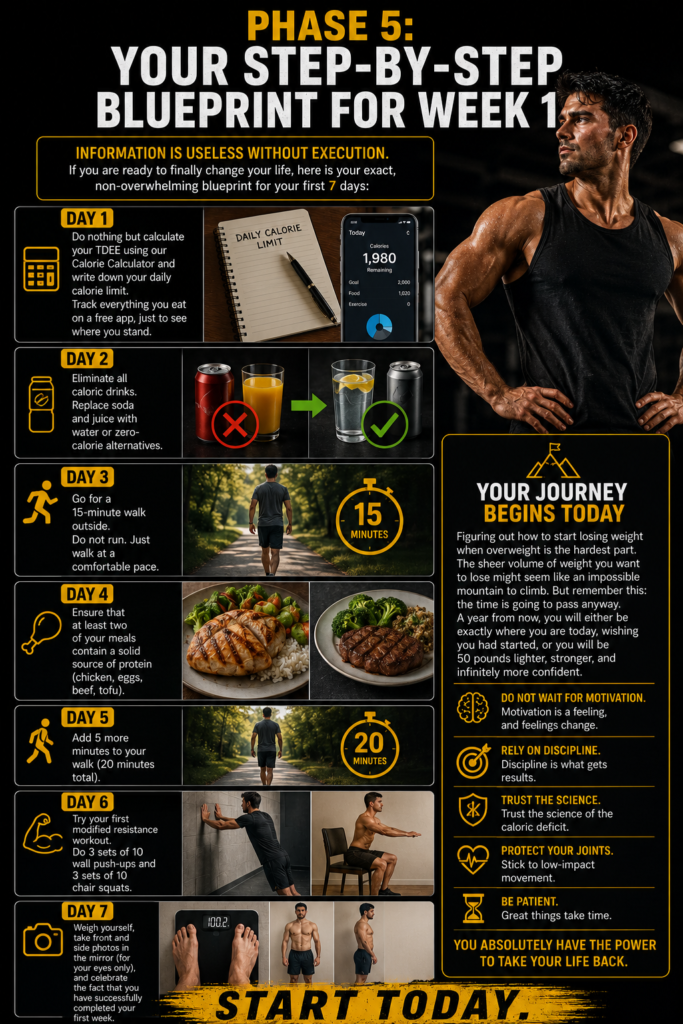
Information is useless without execution. If you are ready to finally change your life, here is your exact, non-overwhelming blueprint for your first 7 days:
- Day 1: Do nothing but calculate your TDEE using our Calorie Calculator and write down your daily calorie limit. Track everything you eat on a free app, just to see where you stand.
- Day 2: Eliminate all caloric drinks. Replace soda and juice with water or zero-calorie alternatives.
- Day 3: Go for a 15-minute walk outside. Do not run. Just walk at a comfortable pace.
- Day 4: Ensure that at least two of your meals contain a solid source of protein (chicken, eggs, beef, tofu).
- Day 5: Add 5 more minutes to your walk (20 minutes total).
- Day 6: Try your first modified resistance workout. Do 3 sets of 10 wall push-ups and 3 sets of 10 chair squats.
- Day 7: Weigh yourself, take front and side photos in the mirror (for your eyes only), and celebrate the fact that you have successfully completed your first week.
Your Journey Begins Today
Figuring out how to start losing weight when overweight is the hardest part. The sheer volume of weight you want to lose might seem like an impossible mountain to climb. But remember this: the time is going to pass anyway. A year from now, you will either be exactly where you are today, wishing you had started, or you will be 50 pounds lighter, stronger, and infinitely more confident.
Do not wait for motivation. Motivation is a feeling, and feelings change. Rely on discipline. Trust the science of the caloric deficit, protect your joints with low-impact movement, and be patient with your body. You absolutely have the power to take your life back. Start today.