

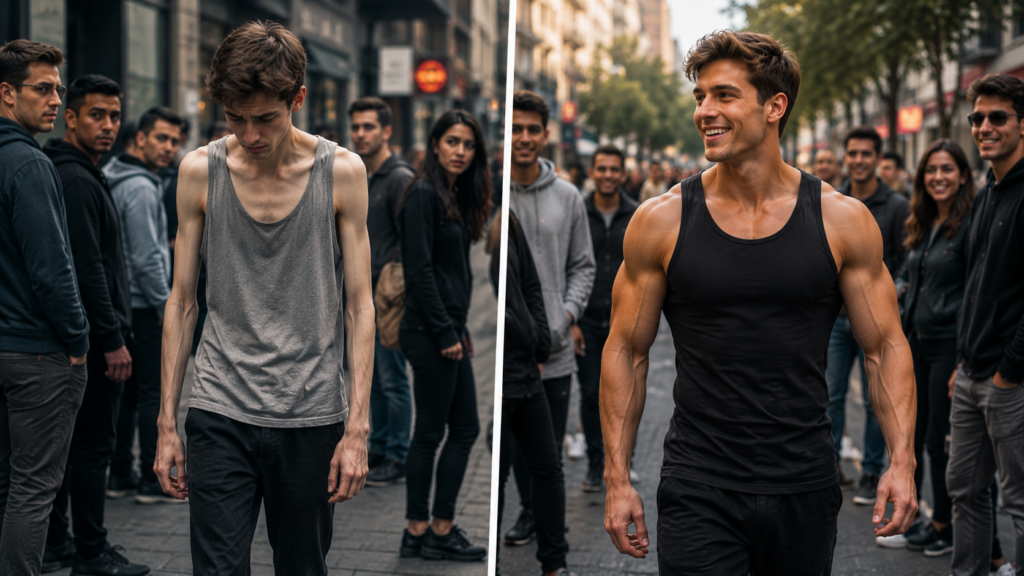
Let’s address the elephant in the room. Summer arrives, you put on a standard medium-sized t-shirt, and the sleeves hang loosely around your upper arms like fabric draped over a broomstick. You pull the sleeves up slightly, hoping to make your arms look bigger, but the reality is undeniable: You suffer from what the fitness community jokingly calls “Noodle Arms.”
As a sports scientist and human performance specialist, I have worked with hundreds of hardgainers, and I can tell you that weak, skinny arms are the number one source of gym insecurity for young men.
Because of this insecurity, you do what every other skinny guy does. You walk into the gym, grab a pair of dumbbells, and perform endless sets of bicep curls. You curl until your arms are numb. You curl in front of the mirror. You try preacher curls, hammer curls, and cable curls. Yet, months pass, and the tape measure doesn’t lie: your arms haven’t grown a single fraction of an inch.
Why? Because your approach to arm training violates the fundamental laws of human physiology and biomechanics. You are trying to force a biological adaptation using the wrong tools.
Today, we are going to dismantle the bro-science. I am going to explain exactly why your arms refuse to grow, and I will give you the biomechanical blueprint to force thick, dense muscle tissue onto your arms.
1. The Triceps Dominance Rule: You Are Focusing on the Wrong Muscle

When a skinny guy wants bigger arms, he immediately thinks of the biceps. He flexes his arm in the mirror, looking at the peak of the bicep, completely ignoring the massive real estate on the back of his arm.
From an anatomical and biomechanical standpoint, the biceps brachii makes up only about 30% to 35% of your total upper arm mass. The triceps brachii—the muscle on the back of your arm—makes up the other 65% to 70%.
Read that again. The triceps muscle is literally twice the size of the bicep.
If you are spending 45 minutes doing bicep curls and only 15 minutes doing light tricep press-downs, you are neglecting the largest engine in your arm. If you want your arms to look massive when they are resting at your sides—if you want them to actually fill out the sleeves of a t-shirt—you must build thick, powerful triceps.
The Scientific Fix: You must prioritize heavy tricep extension movements. But we are not talking about light cable kickbacks. We need movements that allow for maximum mechanical tension. Exercises like the Close-Grip Barbell Bench Press and Weighted Parallel Bar Dips force your triceps to move massive loads, recruiting high-threshold motor units that cable exercises simply cannot reach.
2. The “15-Pound Systemic Growth” Biological Law

Here is a harsh physiological reality that most fitness influencers will never tell you: Your body is a highly proportional biological machine.
The human body does not like extreme imbalances. It will not allow you to have 18-inch, massive arms attached to a 130-pound, fragile torso. It violates the body’s internal sense of homeostasis and structural integrity.
There is a widely accepted metric in sports science regarding arm hypertrophy: To add 1 inch of solid circumference to your arms, you generally need to gain 10 to 15 pounds of overall body weight.
You cannot isolate a small muscle group and expect it to grow indefinitely while the rest of your body remains in a caloric deficit or maintenance phase. If your arms are stuck at 11 inches, and you weigh 140 pounds, no amount of bicep curls will give you 14-inch arms. You must eat in a caloric surplus, trigger systemic (whole-body) anabolism, and push your body weight up to 170 pounds.
The Scientific Fix: Stop treating your arms as a separate entity. Arm growth is a byproduct of overall bodily growth. If you are not drinking your mass-gainer shakes, eating in a 500-calorie surplus, and gaining weight on the scale every month, your arms will remain exactly the same size, no matter how many curls you do.
3. The Compound Overload Principle (How Heavy Back and Chest Training Builds Arms)
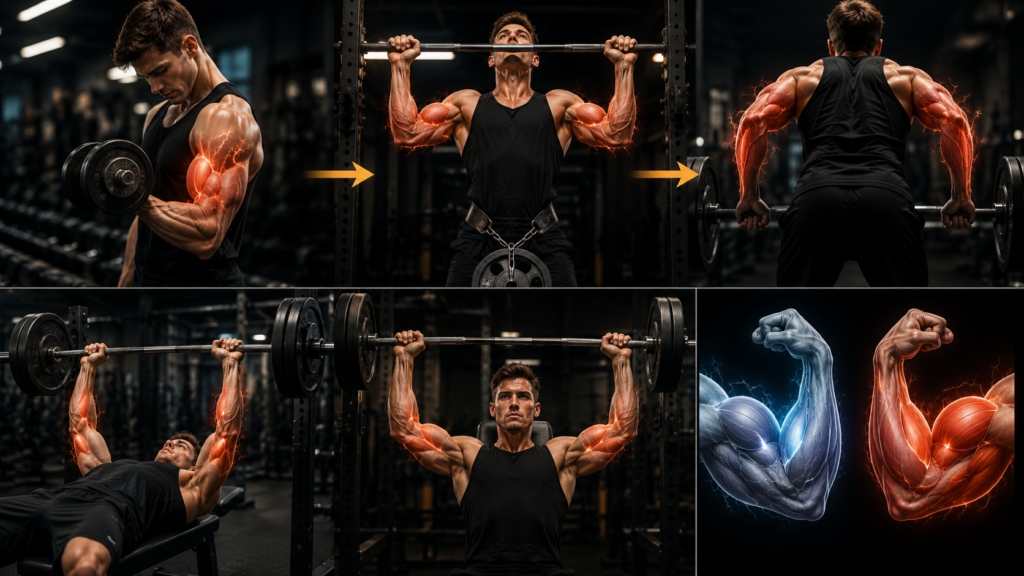
Let’s look at the nervous system. When you perform a standing dumbbell curl with 20 pounds, the Central Nervous System (CNS) sends a relatively weak electrical signal to the bicep. The mechanical tension is low.
Now, imagine you are performing a heavy Weighted Chin-Up with a 45-pound plate strapped to your waist. Your body is pulling over 200 pounds of total resistance through space. To accomplish this, the CNS fires a massive electrical signal, recruiting every available muscle fiber in your lats, traps, and—crucially—your biceps.
Your biceps are placed under extreme, agonizing mechanical tension. The micro-trauma inflicted on the bicep fibers during a heavy chin-up or a heavy barbell row is exponentially greater than anything a light dumbbell curl could ever achieve.
The same applies to the triceps. A heavy Barbell Bench Press or Overhead Military Press forces the triceps to lock out massive amounts of weight. The triceps act as the primary synergist (assisting muscle) in every pressing movement you do.
The Scientific Fix: Your arms get their strongest growth stimulus from heavy compound lifts. If you want big biceps, get terrifyingly strong at Underhand Barbell Rows and Weighted Chin-ups. If you want huge triceps, get incredibly strong at the Bench Press and Overhead Press. Isolation exercises (curls and extensions) should only make up 20% of your arm training. The other 80% comes from heavy pulling and pressing.
4. The Frequency Paradox: Why Smashing Your Arms Once a Week is Failing
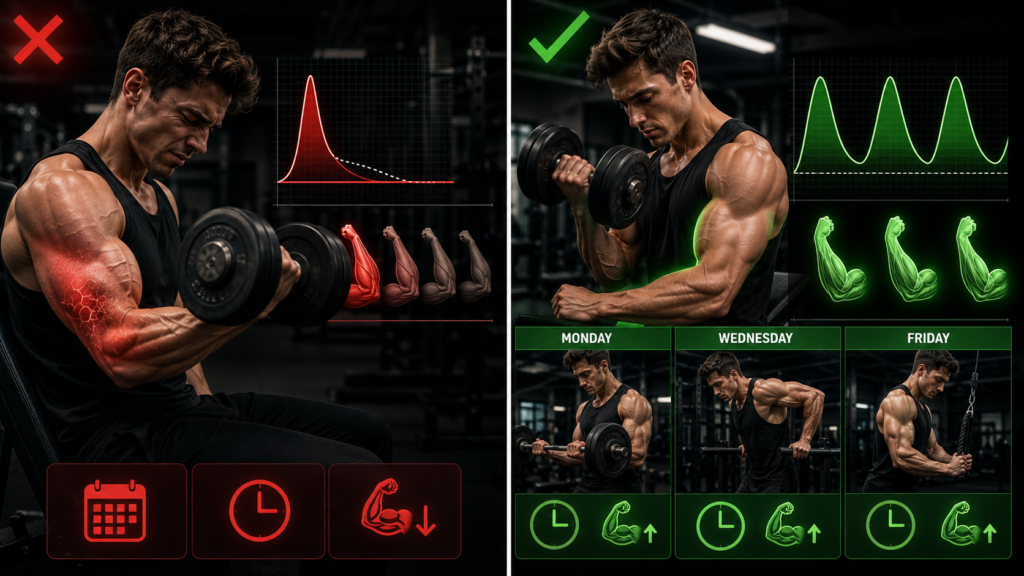
The traditional “Bro-Split” dictates that you have an “Arm Day” on Friday where you do 15 sets of biceps and 15 sets of triceps. For a natural hardgainer, this is a biological catastrophe.
Arms are small muscle groups. Unlike your legs or your back, they cannot handle massive amounts of volume in a single session without experiencing severe inflammation and delayed recovery. When you do 15 sets of biceps in one day, you exceed the “Maximum Recoverable Volume” (MRV). The excess sets become “junk volume,” which only breaks the muscle down further without triggering any extra protein synthesis.
Furthermore, Muscle Protein Synthesis (the biological process of building new tissue) peaks at around 24 hours post-workout and returns to baseline within 48 hours. If you train arms only on Friday, they spend Monday through Thursday shrinking.
The Scientific Fix: High frequency, low volume. Instead of doing 15 sets of arms on one day, do 3 sets of biceps and 3 sets of triceps on Monday, Wednesday, and Friday at the end of your full-body compound workouts. You are now triggering the growth signal three times a week, but the volume is low enough that your arms can actually recover and build new tissue between sessions.
5. The Isometrics and Squeeze: Mastering the Mind-Muscle Connection
While heavy compound movements are the cake, isolation exercises are the icing. But when skinny guys do perform curls, they usually do them entirely wrong.
Walk into the gym and watch a hardgainer curl. They swing their hips, they drop their shoulders, and they use momentum to throw the weight up. By doing this, they remove the tension completely from the bicep and shift it to the lower back and front deltoids.
In sports science, we measure “Time Under Tension” (TUT). For an isolation exercise to cause hypertrophy, the target muscle must be under continuous, agonizing tension throughout the entire range of motion.
The Scientific Fix: Drop your ego and drop the weight. Grab a pair of dumbbells that are 10 pounds lighter than you usually use. Stand against a wall so your back cannot move. Curl the weight up explosively, squeeze the bicep at the very top for a full 2 seconds (this isometric contraction forces blood into the tissue), and then lower the weight agonizingly slowly over 4 seconds. If you do this for 8 to 10 reps, your arms will experience a level of metabolic stress they have never felt before.
Conclusion: The Arm-Building Blueprint
Curing the “Noodle-Arm Epidemic” requires you to completely abandon your ego and submit to human biology. Your arms are not a special, magical body part that defies the laws of physics. They are biological tissue that responds to heavy loads, caloric surpluses, and adequate recovery.
If you want to stretch the sleeves of your t-shirt, here is your ultimate prescription:
- Eat for Systemic Growth: Calculate your caloric surplus and start gaining overall body weight. Remember the 15-pound rule. If the scale isn’t moving, the tape measure around your arms won’t move either.
- Prioritize the Triceps: Stop obsessing over the bicep peak. Build the massive 70% of your arm by focusing on heavy pressing movements like Close-Grip Bench Presses and Dips.
- Compound First, Isolate Second: Let heavy Barbell Rows and Chin-ups do the heavy lifting for your biceps. Save the dumbbell curls for the very end of your workout as a metabolic finisher.
- Increase Frequency: Ditch the dedicated “Arm Day.” Stimulate your arms 2 to 3 times a week with moderate volume to keep Muscle Protein Synthesis constantly elevated.
- Control the Eccentric: When you do isolate, use strict form, squeeze at the top, and control the negative downward phase.
The days of feeling insecure in a t-shirt are over. Stop swinging light dumbbells in front of the mirror. Start eating like a machine, pulling heavy weight, and pressing heavy iron. Your arms will have no biological choice but to grow.