

The Weakness Trap: Why Chasing “The Pump” Is Keeping You Skinny (And The Strength-First Solution)
Let’s set the scene: You walk into the gym, highly motivated. But as you step onto the floor, you look to your left and see a guy effortlessly bench-pressing 225 pounds. You look to your right and see someone squatting with three heavy plates on each side of the bar.
Suddenly, a wave of intimidation washes over you. You feel small. You feel fragile. You feel weak.
To avoid embarrassment, you skip the heavy barbell racks. Instead, you retreat to the safety of the machines or grab a pair of 15-pound dumbbells. You perform high-rep sets of bicep curls, chest flyes, and tricep extensions until your muscles burn and swell with blood. You look in the mirror, see that temporary “pump,” and leave the gym feeling like you’ve accomplished something.
But a year goes by, and while you might be slightly more toned, you are still the exact same size. You are still trapped in a skinny frame.
Why? Because you have fallen into the “Weakness Trap.” You are prioritizing how a muscle looks during a workout instead of how much force it can actually produce.
If you want to stop being the skinny guy, you must stop training like a fitness model and start training like a strength athlete. In this ultimate guide, we are going to dismantle the illusion of the “pump,” explain the biological undeniable link between raw strength and muscle mass, and give you the blueprint to build a foundation of dense, powerful muscle.
1. The Illusion of “The Pump” (Sarcoplasmic vs. Myofibrillar Hypertrophy)
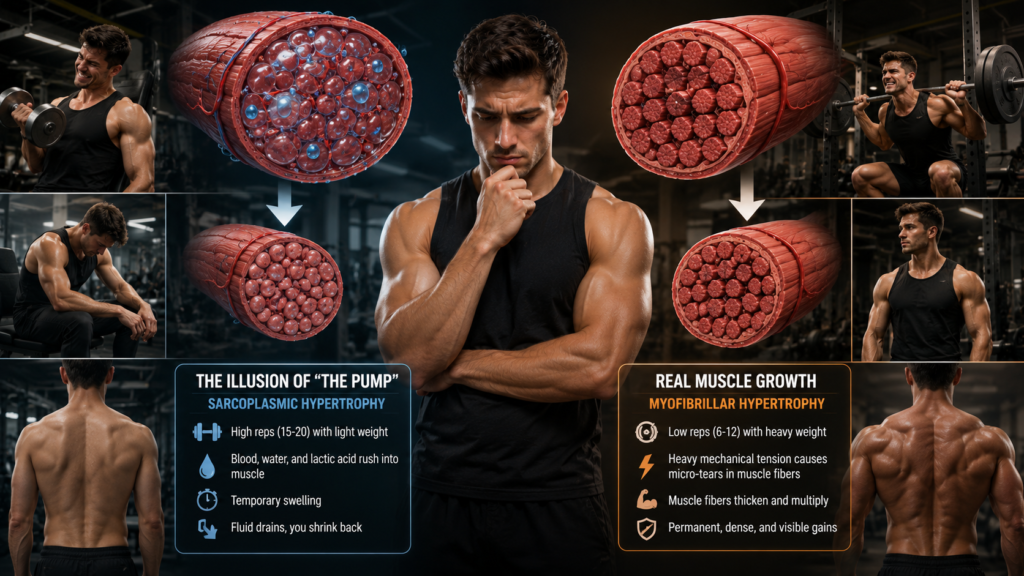
The biggest lie sold to skinny beginners is that feeling a burning sensation and getting a “pump” equals muscle growth.
When you do 15 to 20 reps of a light weight, your body rushes blood, water, and lactic acid into the muscle tissue to deliver oxygen and clear out waste. This causes the muscle to physically swell. In exercise science, this is related to Sarcoplasmic Hypertrophy—an increase in the fluid (sarcoplasm) surrounding the muscle fibers.
The problem? It is entirely temporary. Two hours after you leave the gym, the blood leaves the muscle, the fluid drains, and you shrink right back to your original size.
As a natural Hardgainer, you cannot build permanent, dense mass through fluid retention. You need Myofibrillar Hypertrophy. This is the actual thickening and multiplication of the contractile muscle fibers themselves.
How do you trigger Myofibrillar Hypertrophy? Through heavy, progressive mechanical tension. You have to lift weights that are heavy enough to cause actual micro-tears in the dense muscle fibers. You cannot do this with 15-pound dumbbells. You must subject your body to heavy, challenging loads.
2. The Golden Rule: Size Follows Strength

There is an undeniable law in natural bodybuilding: A bigger muscle is a stronger muscle, and a stronger muscle is a bigger muscle.
Think about it logically. Have you ever seen a man who can Bench Press 250 lbs and Squat 350 lbs who has a small, flat chest and skinny legs? No. It is biologically impossible. The human body is highly adaptive. If you force it to lift increasingly heavy loads, it has no choice but to build thicker, larger muscle tissues to survive the stress.
Skinny guys stay skinny because they try to build size without building a foundation of strength first. If your maximum bench press has been stuck at 90 lbs for the last six months, your chest has absolutely no biological reason to grow any larger. It is already perfectly equipped to handle that 90 lbs.
To break out of the weakness trap, your primary goal in the gym for the next six months should not be “getting big.” Your goal must be “getting terrifyingly strong.” Once you build the raw strength, the physical size will automatically follow as a biological side effect.
3. Escaping the Machine Zone (The Stabilization Effect)

When you feel physically weak, machines are comforting. A chest press machine balances the weight for you. A leg extension machine locks your body in place. You feel safe.
But that safety is exactly what is keeping you small.
When a machine balances the weight for you, it completely shuts off your central nervous system’s need to activate “stabilizer muscles.” When you switch from a Chest Press Machine to a free-weight Barbell Bench Press, you suddenly have to balance the bar in three-dimensional space.
Your brain has to fire signals to your core, your shoulders, your back, and your triceps just to keep the bar from crushing you. This massive recruitment of motor units triggers a central nervous system response that machines simply cannot replicate.
The Strength Fix: Step out of your comfort zone. Stop hiding in the machine section. The Barbell is the greatest mass-building tool ever invented. Yes, it will be humbling at first. You will have to start with very light weights—perhaps just the empty bar. But every champion started with the empty bar. Master the form of free-weight movements, and your body will reward you with unprecedented growth.
4. The “5×5” Protocol: The Hardgainer’s Holy Grail

If you are ready to stop chasing the temporary pump and start building permanent, dense muscle mass, you need a training system designed purely for strength progression. Enter the 5×5 System.
This is one of the oldest, most scientifically proven training protocols in history for taking a weak beginner and turning them into a powerhouse.
How it works: Instead of doing 3 sets of 12 reps with a light weight, you will do 5 sets of 5 reps with a heavy weight.
Why 5 reps? Five reps is the magical intersection between pure strength building and muscle hypertrophy. The weight is heavy enough to force maximal motor unit recruitment, but the volume is high enough to trigger tissue growth without causing excessive central nervous system burnout.
The Foundational Movements: Your entire routine should revolve around these five lifts:
- The Barbell Squat: The undisputed king of lower-body mass.
- The Barbell Deadlift: The ultimate builder of back thickness and total-body power.
- The Barbell Bench Press: For dense chest and tricep development.
- The Overhead Military Press: For broad, powerful shoulders.
- The Barbell Row: For upper back width and bicep strength.
The Golden Rule of 5×5 (Progressive Overload): Every single time you walk into the gym, you must attempt to add weight to the bar. Even if it is just 2.5 pounds on each side. If you lifted 100 lbs for 5 sets of 5 reps this week, you must attempt 105 lbs next week. This constant, relentless demand for more force is what forces the body to build new muscle tissue.
5. Building Psychological Armor

The transition from a skinny, self-conscious beginner to a strong, confident lifter is 80% mental and 20% physical.
You must realize that nobody in the gym is judging you for lifting light weights. The biggest, strongest guys in the gym respect one thing above all else: Effort. They respect the guy who is lifting the empty bar with perfect form, pushing himself to his limits, far more than the guy ego-lifting with terrible form.
Leave your ego at the door. Embrace the fact that you are currently weak, but realize that weakness is a temporary state. It is a starting point, not a life sentence.
Keep a training logbook. Write down every single weight you lift. When you feel discouraged by the mirror, look at the logbook. If your squat has gone from 90 lbs to 135 lbs over the last two months, you are winning. You are forcing adaptation.
The Bottom Line
You cannot fake strength. You cannot build a powerful, intimidating physique using 15-pound dumbbells and cable machines.
It is time to stop playing the victim to your genetics. It is time to step under the heavy barbell, brace your core, and push back against gravity. Feed your body with a massive caloric surplus, prioritize your sleep, and focus entirely on adding weight to the bar.
When you chase the pump, the results disappear in two hours. When you chase raw strength, the results stay with you for a lifetime. Choose strength. For more information, visit our website Fitnexa.com