If you are reading these words right now, I know exactly how you feel. You stand in front of the mirror every morning, inspect your physique, and then step on the scale only to receive the usual shock: the number hasn’t budged.
You go to the gym, lift weights until your lungs burn, and return home to force down a massive plate of rice and chicken. And when you complain to your friends or gym trainers that your weight just won’t go up, they throw that superficial, infuriating advice right in your face: “Bro, the solution is simple… just eat more!”
That specific phrase is enough to drive any “Hardgainer” insane. You swear to them, and to yourself, that you are eating everything in sight. You feel full all the time, and your stomach feels like it’s about to burst from the sheer volume of food. So how can someone tell you to eat more? Is it your genetics? Is your metabolism really so fast that it burns food before it even touches your stomach?
Let’s put an end to these myths today. As an expert in biological and athletic data analysis, I’m going to tell you the harsh, scientific truth: Your fast metabolism is not a curse, and your genetics are not bad. You are simply a victim of a series of dietary and training illusions that are actively destroying your muscle growth.
In this comprehensive guide, we are going to crack the “skinny code” piece by piece. We will look at what is chemically happening inside your body, and I will give you a scientifically proven roadmap to turn your body from a calorie-burning machine into a pure muscle-building factory.
1. The Biggest Illusion: “I Eat Massive Amounts of Food”
This is the very first lie we need to dismantle. Science does not lie, and the laws of thermodynamics spare no one. In order to build muscle and gain weight, you must put more energy (calories) into your body than it burns to stay alive and train.
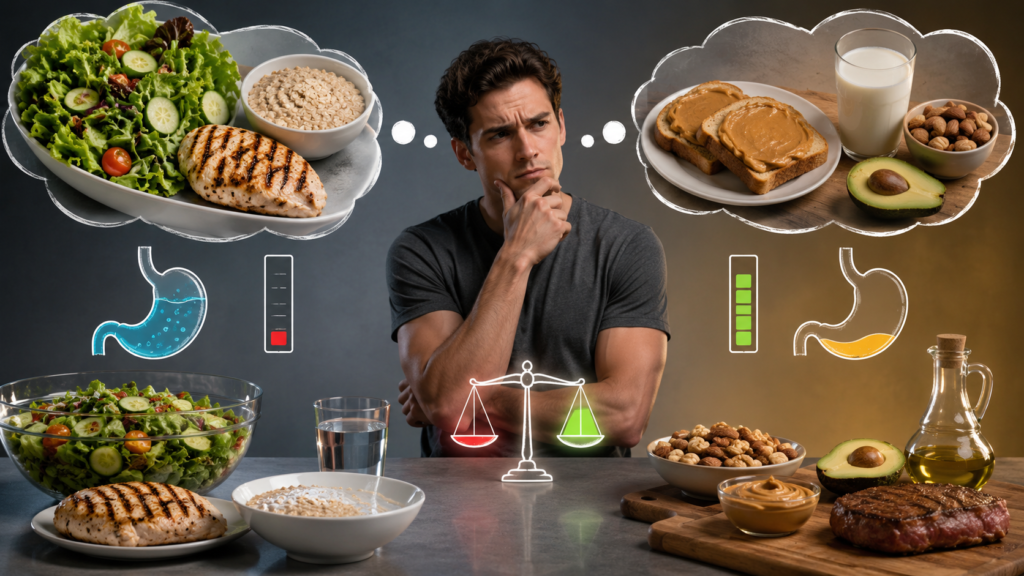
The primary mistake of the skinny guy is measuring food intake by Volume rather than Caloric Density.
What does this mean? Imagine you sit down to eat a meal consisting of a massive bowl of green salad, a dry grilled chicken breast, and a cup of oats cooked in water. Your stomach is now completely full, and you feel so stuffed you can barely breathe. Your brain translates this fullness into: “I just ate a massive meal!”
But the numbers tell a completely different story:
- Massive bowl of salad: ~40 calories.
- Grilled chicken breast: ~165 calories.
- Cup of oats in water: ~150 calories. Total: A mere 355 calories!
You feel stuffed because you filled your stomach with water and fiber, but chemically, you gave your body almost zero real energy to build new tissue. On the other hand, someone else could eat two slices of toast spread with two tablespoons of peanut butter and a glass of whole milk. This is a very small, physically light meal that barely fills the stomach, yet it contains over 600 calories!
The Scientific Fix: Stop relying on your feeling of fullness. Your feelings are deceiving you. Start tracking your calories accurately using tracking tools. More importantly, transition away from high-volume/low-calorie foods (like massive salads and dry chicken) and focus on foods with high caloric density (like nuts, olive oil, peanut butter, avocados, and red meat).”Think you eat enough? Prove it. [Use our Free Hardgainer Reality Check Calculator]”
2. The “Chewing Fatigue” Dilemma & The Magic Solution
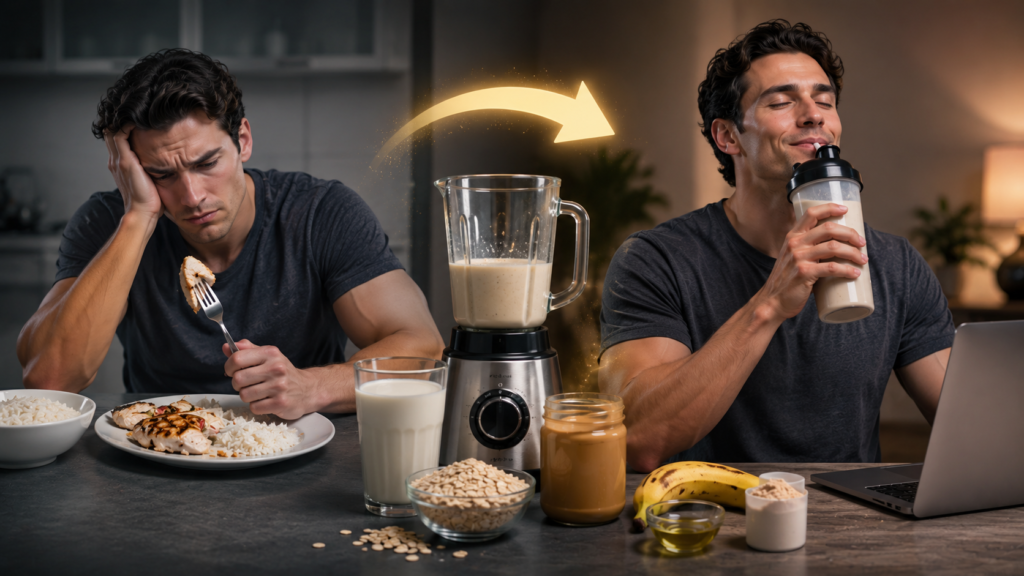
Even if you finally realize that you need 3,000+ calories a day, applying that in the real world when you have a small appetite feels like torture. Constantly chewing dry chicken breasts and plain rice will inevitably lead to what is known as “Chewing Fatigue.” You will reach a point where you literally dread mealtime.
If you cannot chew your calories, you must drink them.
Liquids do not send the same strong satiety (fullness) signals to the brain that solid foods do. They are also digested and absorbed much faster. This is the ultimate secret weapon used by pro bodybuilders during their bulking phases.
Meet the “1000-Calorie Monster”: Don’t waste your money on commercial “Mass Gainers” packed with cheap sugars that will only give you belly fat. Build your own magic shake in your home blender in exactly two minutes:
- 2 Cups of Whole Milk (300 kcal)
- 2 Tablespoons of Peanut Butter (190 kcal)
- 1 Large Banana (105 kcal)
- 1/2 Cup of Dry Oats (150 kcal)
- 1 Tablespoon of Olive Oil (120 kcal – trust me, you won’t even taste it!)
- 1 Scoop of Whey Protein (120 kcal)
With the push of a button, you get over 1,000 calories and roughly 50 grams of protein in a single cup that you can easily sip while watching TV or working on your laptop. Drink this shake once a day alongside your normal meals, and I guarantee the scale will be forced to move.
3. Stop Training Like an “Enhanced Pro Bodybuilder”
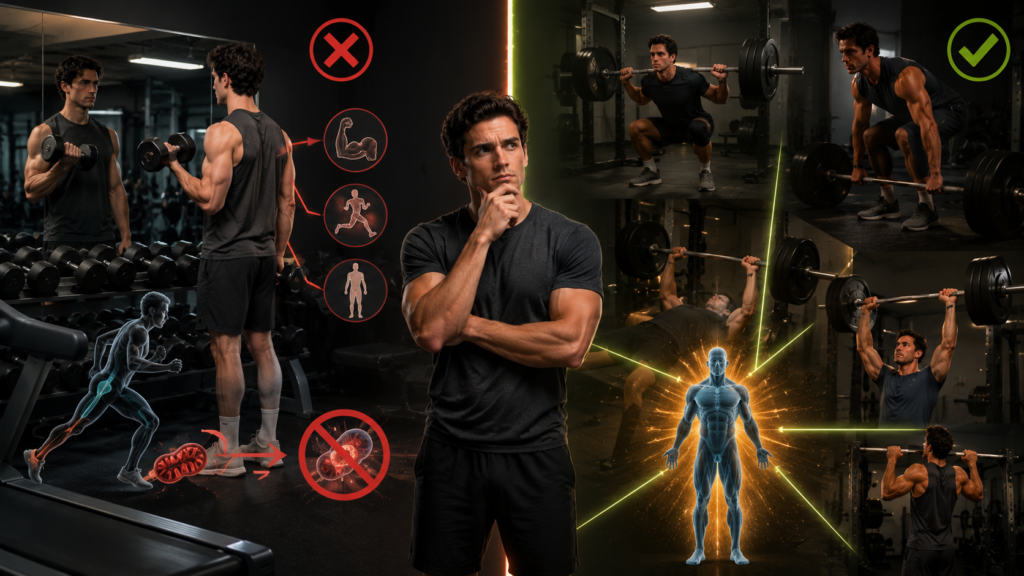
The second fatal mistake hardgainers make is walking into the gym and copying the routines of professional, genetically blessed (or hormonally enhanced) bodybuilders. You see a 130-pound guy standing in front of the mirror doing 5 different isolation exercises for his biceps, or spending 45 minutes on the treadmill before he even touches a weight!
Let me explain your physiology: As a hardgainer, your body has a very limited capacity for Recovery. Every set you perform drains your Central Nervous System (CNS) and depletes your muscular glycogen stores.
When you do small isolation exercises (like dumbbell lateral raises or tricep kickbacks), you burn precious calories and cause minor muscle damage, but you do not stimulate enough of an anabolic hormone release.
As for long, steady-state cardio (like distance running), it activates a biological pathway in the body called AMPK—the endurance pathway. The catastrophic problem here is that activating AMPK chemically shuts down and inhibits mTOR, which is the primary pathway responsible for muscle protein synthesis! You are literally sending a biological signal to your body telling it: “Stop building muscle, we need this energy for running.”
What is the solution? Ignore the tiny isolation movements and focus entirely on Compound Movements. Compound exercises move multiple joints and target massive muscle groups simultaneously. They include:
- Barbell Squats: For the entire lower body and core.
- Deadlifts: To thicken the lower back, hamstrings, and glutes.
- Bench Press: To build the chest, shoulders, and triceps.
- Overhead Military Press: To build massive, dense shoulders.
- Weighted Pull-ups: To widen the back (the V-taper).
When you put 225 lbs on your back and perform a heavy Squat, your entire nervous system sounds the alarm. The brain realizes the body is under immense mechanical stress that could “crush” it, so it triggers a survival response by releasing massive amounts of natural Testosterone and Human Growth Hormone (HGH). This hormonal flood is what builds overall muscle mass on your skinny frame, not lifting pink dumbbells in front of a mirror.
4. The Silent Killer: Cortisol and Sleep Deprivation
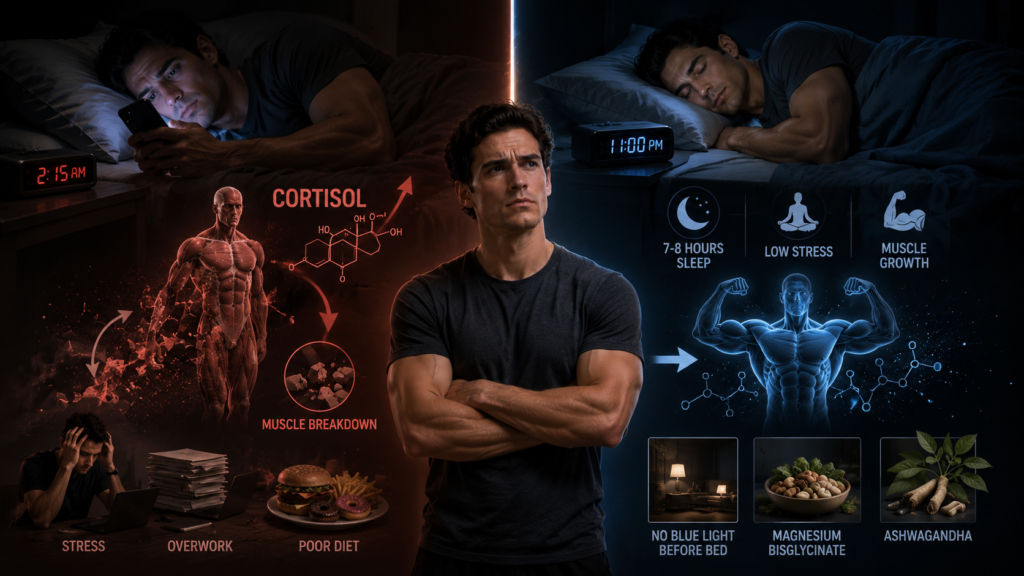
So, you are finally eating well, training smart, and focusing on compound lifts. But the scale is still moving too slowly. Here is where we need to look at the crucial element that 90% of gym-goers ignore: What happens outside the gym?
Muscles do not grow while you are training. During your workout, you are literally tearing and destroying muscle fibers. True growth only happens when you are asleep in a state of deep relaxation.
If you are sleeping less than 7 hours, suffering from fragmented sleep, or living in a highly stressful work/school environment, your body will flood itself with the infamous stress hormone: Cortisol.
Cortisol is a highly Catabolic (muscle-wasting) hormone. Its primary job is to provide quick energy for the body to deal with stress or danger. Where does it get this energy? It literally breaks down the amino acids in the very muscle tissue you are trying so hard to build, converting them into glucose for energy! Yes, chronic stress and lack of sleep are literally eating your muscles from the inside out.
Furthermore, sleep deprivation destroys your Insulin Sensitivity, meaning the carbohydrates you eat won’t be pushed into your muscles for glycogen storage, but will instead be stored as stubborn fat around your lower belly.
The Strict Recovery Protocol:
- Aim for 7 to 8 hours of deep, uninterrupted sleep in a completely dark, cool room.
- Stop scrolling through blue-light-emitting screens (phones/tablets) at least an hour before bed, as they severely disrupt Melatonin production.
- If you are a naturally anxious person, consider introducing natural supplements that support nervous system relaxation, such as Magnesium Bisglycinate or Ashwagandha (after consulting your doctor).
5. Conclusion: There Is No Magic, Only Commitment
Graduating from the “Hardgainer” category and building a powerful, muscular physique is not magic. It doesn’t require mutant genetics, and it certainly doesn’t require dangerous steroids. It all comes down to a clear scientific equation that you must respect and apply rigorously:
- Shatter the Calorie Illusion: Stop filling up on massive, low-calorie salads. Focus on calorically dense foods, and use our site’s calculators to find your exact daily targets.
- Drink Your Calories: Support your daily diet with a 1,000+ calorie monster shake to bypass chewing fatigue and digestive exhaustion.
- Lift Real Weight: Forget isolation machines and endless cardio. Become best friends with the barbell and the heavy compound movements that biologically force your body to adapt and grow.
- Recover Like a Pro: Give your body the rest, deep sleep, and low-stress environment it needs to rebuild what you tore down in the gym.
The question isn’t “When will I see results?” The question is “Will I stay committed long enough to see the results?”
Your body naturally hates change and will resist your attempts to gain weight because change requires vast amounts of energy. But you now have the science, and you have the blueprint. Start applying these principles in your very next meal and your very next workout, and watch how both the scale—and your life—will change forever.
For more helpful information and fitness tools to help you achieve your goals quickly, you can visit our free website Fitnexablog.com and learn more.